

 English
 عربى
عربى
Content
- 1 The Short Answer: What Actually Stops Neck Pain at Night
- 2 Why Your Neck Hurts in the Morning: The Mechanics Behind Sleeping Pain
- 3 Best Sleep Positions for Neck Pain Prevention
- 4 How Memory Foam Products Address the Root Cause of Sleeping Neck Pain
- 5 Pillow Height: The Measurement Most People Get Wrong
- 6 The Mattress Factor: Why Your Bed Matters as Much as Your Pillow
- 7 Pre-Sleep Habits That Directly Reduce Neck Pain Risk
- 8 Daytime Habits That Accumulate Into Nighttime Neck Pain
- 9 Comparing Sleep Support Products: What the Evidence Shows
- 10 When to See a Doctor or Physical Therapist
- 11 A Practical Action Plan: Changes to Make This Week
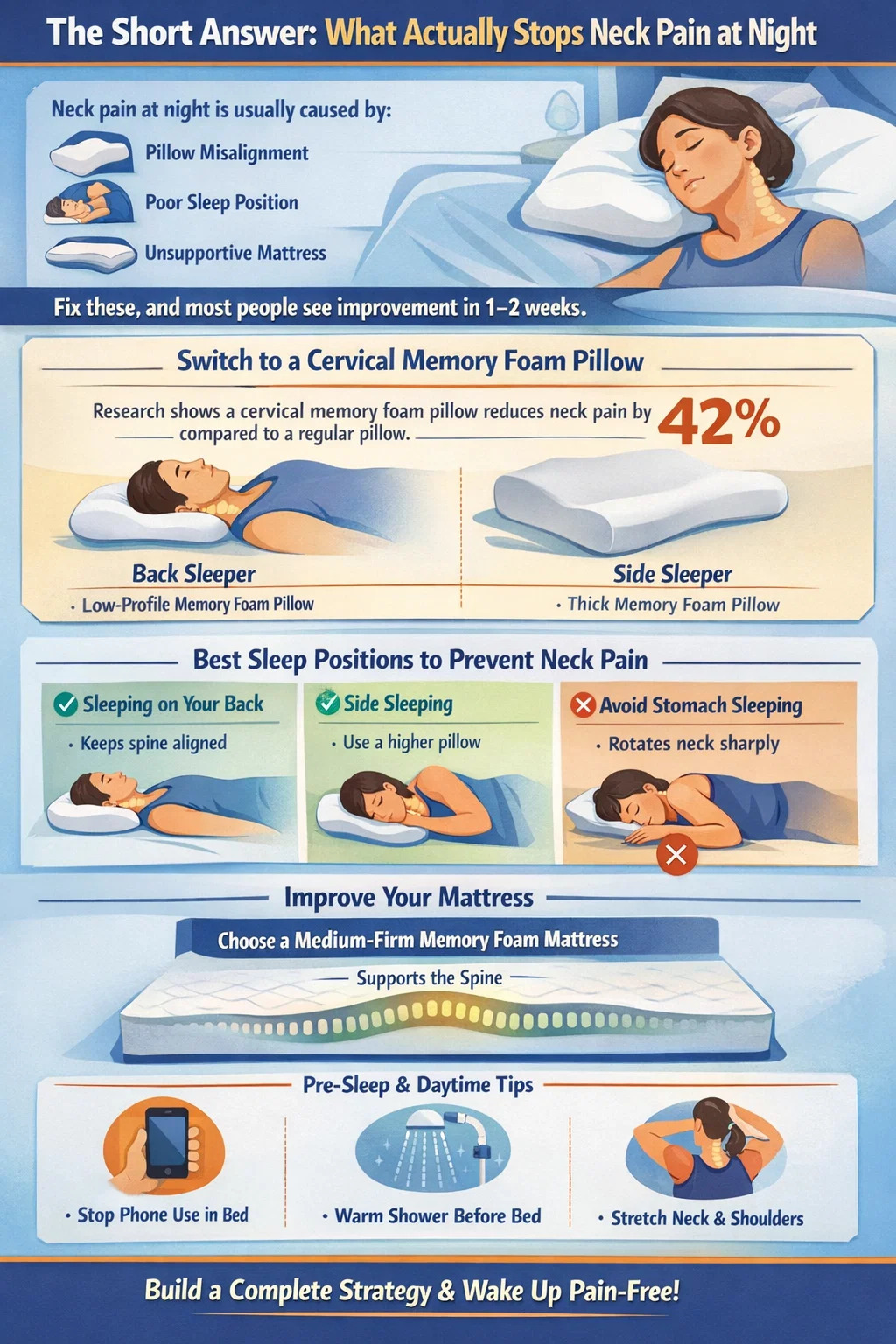
The Short Answer: What Actually Stops Neck Pain at Night
Neck pain while sleeping is almost always caused by one of three things: a pillow that puts your cervical spine out of alignment, a sleep position that strains your muscles for hours at a time, or a mattress that fails to support the natural curve of your spine. Fix those three variables, and most people see dramatic improvement within one to two weeks.
The single most effective change the majority of people can make is switching to a memory foam pillow sized correctly for their sleep position. Research published in the journal Complementary Therapies in Clinical Practice found that participants using a cervical memory foam pillow reported a 42% reduction in neck pain intensity compared to those using a standard polyester-fill pillow over an eight-week trial. That alone tells you where to start.
This guide goes through every contributing factor in detail — sleep posture, pillow selection, mattress support, pre-sleep habits, and daily stretches — so you can build a complete strategy rather than just swapping one product and hoping for the best.
Why Your Neck Hurts in the Morning: The Mechanics Behind Sleeping Pain
Your cervical spine — the seven vertebrae running from the base of your skull to the top of your thoracic spine — has a natural inward curve called a lordosis. When you sleep, that curve needs to be maintained for the full duration of the night. The moment your head drops too low, tilts too far to one side, or gets pushed forward by an overstuffed pillow, the muscles and ligaments surrounding those vertebrae are placed under sustained tension for hours. Unlike a momentary bad posture during the day that you correct within minutes, sleep posture holds your neck in the same problematic position for six to nine hours straight.
The muscles most frequently involved are the sternocleidomastoid, the trapezius, and the levator scapulae. When these muscles contract or stretch abnormally throughout the night, you wake up with stiffness, aching, or a sharp pain that can radiate into the shoulders, upper back, or even down the arms. In more persistent cases, the intervertebral discs between the cervical vertebrae can become irritated, adding a deeper, more chronic layer of discomfort.
A 2021 survey by the American Chiropractic Association found that nearly 70% of people who reported chronic neck pain attributed it at least partly to their sleeping setup — specifically their pillow height or sleep position. That figure makes sense when you consider just how many hours the average adult spends with their head in a fixed posture.
The Role of Muscle Memory and Habitual Postures
People who spend long hours looking at screens during the day often develop a forward-head posture that carries over into sleep. When you lie down with a forward-tilted head already, a standard pillow only worsens the angle. Over time, the surrounding musculature adapts to this position, making it harder to correct without deliberate intervention. Understanding this connection between daytime posture and nighttime pain is critical for anyone who has tried changing their sleep position without success.
Best Sleep Positions for Neck Pain Prevention
Not all sleep positions are created equal when it comes to cervical spine health. Some are almost universally recommended by physical therapists and orthopedic specialists, while others consistently cause or worsen neck problems.
Sleeping on Your Back: The Gold Standard
Back sleeping is widely considered the best position for spinal alignment, including the cervical spine. When lying on your back, gravity distributes weight evenly across the broadest surface area of your body, and a correctly sized pillow simply needs to fill the gap between your head and the mattress — typically around 4 to 5 centimeters for the average adult. In this position, the neck rests in a neutral posture without rotating or lateral flexing. Many people who switch to back sleeping from stomach sleeping report that morning neck stiffness disappears within days.
If you choose to sleep on your back, a low-profile memory foam pillow or a contoured cervical memory foam pillow that cradles the natural curve of the neck is generally the most effective choice. The goal is to keep your ears, shoulders, and hips aligned in a straight horizontal line.
Side Sleeping: Effective with the Right Support
Side sleeping is the most common position globally, with studies suggesting roughly 60 to 70% of adults default to it. It can be perfectly healthy for the neck, but it demands a significantly taller pillow than back sleeping because the gap between the mattress and the side of your head is much larger — typically 10 to 15 centimeters for the average adult, depending on shoulder width. Using a pillow that is too flat in this position is one of the leading causes of lateral neck flexion and morning pain.
Memory foam products designed specifically for side sleepers are thicker and often have a shoulder cutout or a raised edge to provide the right loft without excessive firmness. Placing a pillow between the knees while side sleeping also improves overall spinal alignment, which indirectly reduces strain on the cervical spine by preventing the lower back from twisting and pulling the rest of the spine out of line.
Stomach Sleeping: Consistently the Worst Choice
Sleeping face down forces the neck to rotate 90 degrees to one side for hours at a time. This position places maximum rotational stress on the cervical vertebrae and puts the neck muscles in a state of continuous asymmetric contraction. Spine specialists and physical therapists are virtually unanimous on this point: stomach sleeping is the single sleep position most likely to cause or aggravate neck pain.
Breaking the habit can be difficult, but it is achievable. Placing a body pillow along your side creates a physical barrier that discourages rolling onto your stomach. Some people sew a tennis ball into the front of a sleep shirt as a behavioral deterrent. It takes roughly two to four weeks of consistent effort to establish a new default sleep position, but the reduction in neck pain is typically noticeable well before that point.
How Memory Foam Products Address the Root Cause of Sleeping Neck Pain
Memory foam — technically known as viscoelastic polyurethane foam — was originally developed by NASA in the 1960s to improve astronaut seat cushioning. Its defining property is that it responds to both heat and pressure, softening and contouring precisely to the shape pressing into it, then slowly returning to its original form when that pressure is removed. For sleep applications, this means the foam molds to the specific shape of your head, neck, and shoulders rather than just pushing back against them uniformly the way a traditional spring or polyester pillow would.
This contouring behavior is what makes memory foam products genuinely useful for neck pain prevention, not just a marketing claim. When a memory foam pillow shapes itself to the curve of your neck, it supports the cervical lordosis continuously rather than leaving pressure points or gaps. A conventional pillow compresses under your head and loses loft over the course of the night, gradually allowing your neck to sink into a hyperextended position. Memory foam maintains its supportive shape for far longer.
Memory Foam Pillows: Types and What Each Offers
Not all memory foam pillows are structurally the same. The four main types each have distinct advantages depending on your sleep position, body size, and personal comfort preferences.
- Solid block memory foam pillows: Made from a single piece of molded foam. They offer consistent, uniform support across the entire surface. Good for back sleepers who want a stable, predictable feel. The downside is that they retain heat more than other types and cannot be adjusted for loft.
- Shredded memory foam pillows: Filled with small pieces of memory foam rather than a single block. These are adjustable — you can add or remove fill to customize height — and sleep significantly cooler. They are a good option for side sleepers who need more loft and for people who run warm at night.
- Contoured cervical memory foam pillows: Molded with two different loft heights — a higher ridge at the bottom for neck support and a lower center zone for head placement. These are specifically engineered for cervical alignment and are frequently recommended by physical therapists and chiropractors. Most effective for back sleepers with moderate to severe neck pain.
- Gel-infused memory foam pillows: Standard memory foam infused with cooling gel beads or a gel layer. The memory foam properties are identical to a standard solid pillow, but the gel dissipates body heat more effectively. Recommended for those who find traditional memory foam uncomfortably warm.
Memory Foam Mattresses and Their Contribution to Neck Health
While a pillow directly supports the neck, the mattress determines overall spinal alignment from head to toe. A mattress that is too soft allows heavier areas like the hips to sink, throwing the lumbar spine into flexion and causing a compensatory curve further up the spine that includes the cervical region. A mattress that is too firm creates pressure points at the hips and shoulders in side sleepers, causing the entire spine to bow sideways.
A medium-firm memory foam mattress is consistently rated most effective for spinal alignment across multiple sleep position studies. A systematic review published in Sleep Health in 2015 analyzed nine randomized controlled trials and found that medium-firm mattresses outperformed both soft and firm options for reducing back and neck pain during sleep. Memory foam mattresses in the medium-firm category (typically 5 to 7 on a 10-point firmness scale) provided the best balance of pressure relief and support for most body types.
When paired with an appropriately sized memory foam pillow, a medium-firm memory foam mattress creates a fully supportive sleep surface where every section of the spine, including the cervical vertebrae, is maintained in a neutral position throughout the night.
Memory Foam Pillow Firmness: How to Choose Correctly
The density and firmness of a memory foam pillow matters as much as its shape. Density is measured in pounds per cubic foot (PCF). For cervical support purposes:
| Density (PCF) | Feel | Best For | Neck Support Level |
|---|---|---|---|
| 2.0 – 3.0 PCF | Soft, sinks quickly | Light sleepers, children | Low – insufficient for chronic pain |
| 3.0 – 4.5 PCF | Medium, balanced contouring | Back and side sleepers | Good – ideal for most adults |
| 4.5 – 6.0 PCF | Firm, slow response | Heavier individuals, broad shoulders | Excellent – maximum support |
Most adults with average body weight and shoulder width will find the 3.0 to 4.5 PCF range optimal. At this density, the foam contours to the neck without feeling too rigid or too yielding.
Pillow Height: The Measurement Most People Get Wrong
Pillow loft — the height of the pillow when uncompressed — is arguably the single most misunderstood variable in sleep neck pain. Most people choose a pillow based on how soft or comfortable it feels when they test it in a store while sitting upright, which tells them almost nothing about how it will perform during actual sleep.
The correct pillow height depends on your sleep position and shoulder width:
- Back sleepers need a low-loft pillow, typically 7 to 10 cm. The pillow needs to fill only the small gap between the back of the head and the mattress while supporting the neck curve. A tall pillow in this position pushes the chin toward the chest, straining the posterior neck muscles.
- Side sleepers need a medium-to-high loft pillow, typically 10 to 15 cm depending on shoulder width. The pillow must bridge the full width of the shoulder to keep the spine level. Broader shoulders require more loft. If your pillow is too low as a side sleeper, your neck droops toward the mattress, stretching the muscles on the upper side and compressing those on the lower side.
- Stomach sleepers (transitioning away): If you cannot yet break the habit, use the thinnest possible pillow or no pillow under your head. Instead, place a flat pillow under the pelvis to reduce lower back arch, which also slightly reduces neck rotation stress.
A practical test: lie in your normal sleep position, have someone look at your neck from the foot of the bed. Your cervical spine should form a straight extension of the rest of your spine with no visible lateral bend or forward tilt. If it does, your pillow height is correct. If not, adjust accordingly.
The Mattress Factor: Why Your Bed Matters as Much as Your Pillow
A perfect pillow on a poor mattress will not solve chronic neck pain. The mattress sets the foundation from which the pillow works. If the mattress causes spinal misalignment below the cervical region, that misalignment propagates upward.
Signs Your Mattress Is Contributing to Neck Pain
- You wake up with neck or back pain that gradually eases within 30 minutes of getting up and moving around — this is a classic sign of sleep-surface-induced pain rather than a structural spinal problem.
- You sleep better on hotel beds, a guest room mattress, or your couch than in your own bed.
- You can feel or see visible sagging in the center of your mattress. A sag greater than 2.5 cm is associated with a significant increase in back and neck pain during sleep, according to research from Oklahoma State University.
- Your mattress is more than seven to eight years old. Most mattresses lose meaningful structural integrity within this timeframe regardless of how they look on the surface.
Memory Foam Mattress Toppers as a Middle-Ground Solution
If replacing a full mattress is not feasible, a memory foam mattress topper can meaningfully improve spinal alignment at a fraction of the cost. A 5 to 7 cm thick memory foam topper rated at medium-firm density placed on top of an aging or too-firm mattress can restore much of the pressure-relieving and contouring benefit of a new memory foam mattress. This is not a permanent substitute, but many people report significant reduction in morning neck stiffness within two weeks of adding a quality memory foam topper to their existing sleep surface.
Pre-Sleep Habits That Directly Reduce Neck Pain Risk
The hour before you sleep is more influential on nighttime neck pain than most people realize. Several common pre-sleep behaviors create or worsen neck muscle tension before you even lie down.
Stop Looking at Your Phone in Bed
Scrolling a phone while lying in bed almost always involves sustained neck flexion — chin toward chest — for 20, 30, or 60 minutes before sleep. Biomechanical research from the Spine Research Institute of Australia calculated that looking downward at a phone at 60 degrees of neck flexion places approximately 27 kilograms of effective force on the cervical spine — roughly six times the force of a neutral head position. Going to sleep immediately after this extended flexion period means the neck muscles carry residual tension into the night.
If you use a phone or tablet before sleep, hold it at eye level or use a stand. It changes the mechanics entirely.
Warm Shower or Bath Before Bed
A warm shower or bath 60 to 90 minutes before sleep relaxes the trapezius and surrounding cervical musculature through a combination of heat and the parasympathetic nervous system response triggered by the subsequent drop in body temperature. People with chronic neck tension who add a nightly warm shower consistently report better morning neck mobility. This costs nothing and requires no equipment change.
Neck and Shoulder Stretching Routine Before Sleep
Five to ten minutes of gentle neck and shoulder stretching before bed reduces accumulated muscle tension from the day and prepares the cervical musculature for a relaxed, extended rest. The following stretches are consistently recommended by physical therapists for neck pain prevention:
- Lateral neck stretch: Gently tilt your right ear toward your right shoulder until you feel a mild stretch along the left side of your neck. Hold for 20 to 30 seconds. Repeat on the left side. Three rounds per side.
- Chin tuck: While sitting or standing, draw your chin straight back (creating a gentle double chin effect) without tilting your head. This activates the deep cervical flexors and counteracts forward head posture. Hold for 5 seconds, repeat 10 times.
- Trapezius stretch: Reach your right arm across your chest, use your left hand to gently pull it closer. Hold 20 seconds each side. This releases the upper trapezius, one of the most commonly tight muscles in people with neck pain.
- Doorway chest opener: Place both forearms on a doorframe and gently lean forward until you feel a stretch across the chest and front of the shoulders. This counteracts the protracted shoulder position that many desk workers develop, which contributes to neck tension.
None of these should cause pain. If any stretch produces sharp discomfort rather than a manageable pulling sensation, stop and consult a physical therapist before continuing.
Daytime Habits That Accumulate Into Nighttime Neck Pain
Neck pain while sleeping does not always originate in the bed. The tension and structural strain that cause you to wake up sore often accumulate during the day and simply reach their peak expression overnight when you are immobile.
Workstation Setup and Screen Height
The top of your monitor should be at or slightly below eye level so that your gaze is roughly horizontal or very slightly downward. Monitors that are too low require continuous neck flexion. Those too high cause sustained extension. Either way, the result is muscle fatigue and accumulated cervical tension by end of day. A standing desk used part-time is far less effective than simply adjusting monitor height correctly on a standard desk.
The distance matters too: your screen should be approximately 50 to 70 cm from your eyes — far enough that you are not leaning forward to read, close enough that you are not straining your vision. Both conditions create compensatory neck postures.
Regular Movement Breaks
Sustained static neck posture, even a reasonably good one, causes progressive muscle fatigue and tension. Setting a timer to take a two to three minute movement break every 45 to 60 minutes — standing, walking, doing a few shoulder rolls and chin tucks — is clinically more effective for neck pain prevention than any ergonomic chair or premium accessory.
Carrying Bags and Load Asymmetry
Carrying a heavy bag consistently on the same shoulder elevates that shoulder, creates a lateral cervical tilt, and activates compensatory tension throughout the neck and upper back. Over months or years, this produces measurable structural imbalances. Using a backpack with both straps, or alternating shoulder bag sides, distributes load symmetrically and reduces the cumulative effect on the cervical spine.
Comparing Sleep Support Products: What the Evidence Shows
The market for products designed to prevent neck pain during sleep is large and sometimes confusing. Understanding which categories of products have actual clinical evidence behind them and which are primarily marketing helps you spend money where it will have the most impact.
| Product | Evidence Level | Best Used For | Limitations |
|---|---|---|---|
| Contoured cervical memory foam pillow | Strong – multiple RCTs | Back sleepers with chronic neck pain | Less effective for active side sleepers |
| Shredded memory foam pillow (adjustable) | Good – observational and user studies | Side sleepers needing custom loft | Requires correct adjustment |
| Medium-firm memory foam mattress | Strong – systematic review evidence | All sleep positions, whole-spine alignment | High upfront cost |
| Memory foam mattress topper (5–7 cm) | Moderate – limited RCTs, good user data | Existing firm mattress upgrade | Not a permanent replacement |
| Buckwheat hull pillow | Limited – anecdotal, some small studies | Hot sleepers who dislike foam | Noisy, less predictable contouring |
| Magnetic or infrared therapy pillow | Very weak – no strong clinical evidence | No evidence-based recommendation | Likely no meaningful benefit |
The clear take from this comparison is that memory foam products — specifically cervical or adjustable pillows and medium-firm mattresses — have the strongest evidence base for preventing neck pain during sleep. Everything else either lacks clinical support or offers a narrow application.
When to See a Doctor or Physical Therapist
Most sleep-related neck pain resolves within two to four weeks of making the changes described above. But some neck pain during or after sleep is a signal of an underlying structural or neurological issue that lifestyle changes alone will not fix.
See a healthcare provider promptly if you experience any of the following:
- Pain that radiates down the arm, into the hand, or involves numbness, tingling, or weakness in the fingers — these are potential signs of nerve root compression (cervical radiculopathy).
- Neck pain accompanied by severe headache, particularly one that comes on suddenly or is described as the worst headache of your life.
- Pain that is constant, unrelenting, and does not improve with position changes, rest, or over-the-counter anti-inflammatory medication after two weeks.
- Neck pain following any kind of trauma — a car accident, a fall, or a sports injury — even if the pain seems mild initially.
- Unexplained weight loss alongside neck pain, which can occasionally signal a systemic condition requiring investigation.
A physiotherapist can assess your specific cervical mobility, identify which muscles are weak or overactive, and give you a tailored exercise programme that addresses your exact movement patterns. This is typically far more effective and faster than self-managing a problem that has structural components requiring specific intervention.
A Practical Action Plan: Changes to Make This Week
Rather than overwhelming yourself with every possible change at once, the following sequence prioritises interventions by impact and ease of implementation.
- Day 1–2: Assess your current pillow height against your sleep position. If you are a side sleeper using a flat or medium pillow, add a folded towel underneath it temporarily to increase loft. Note whether morning stiffness changes.
- Day 3–5: Begin the pre-sleep stretching routine — lateral neck stretch, chin tucks, trapezius stretch — for 5 minutes each night. Do this consistently for at least two weeks before evaluating results.
- Week 2: If pillow height adjustment showed promise, invest in a correctly sized shredded or contoured memory foam pillow appropriate for your sleep position. Allow three to five nights of adjustment before evaluating.
- Week 3: Evaluate your mattress. If it is sagging visibly or more than seven years old, consider a medium-firm memory foam topper as an intermediate step.
- Ongoing: Address daytime posture, monitor screen height, set movement break reminders, and reduce screen use in bed. These compounding changes progressively reduce the accumulated tension that expresses itself as nighttime neck pain.
Most people who implement all five stages in this sequence report a meaningful and sustained reduction in sleep-related neck pain within three to four weeks. The combination of correct pillow support through quality memory foam products, improved sleep position, and reduced daytime tension accumulation addresses the problem from every angle simultaneously, rather than relying on any single fix.