

 English
 عربى
عربى
Content
- 1 The Short Answer: Yes, But It Depends on the Right Fit
- 2 How Memory Foam Actually Supports the Cervical Spine
- 3 Memory Foam Pillow Types and Which One Works Best for Neck Pain
- 4 The Right Pillow Height Matters More Than You Think
- 5 Who Benefits Most from a Memory Foam Pillow
- 6 Situations Where a Memory Foam Pillow May Not Be the Best Choice
- 7 What to Look for When Buying a Memory Foam Pillow for Cervical Support
- 8 How to Use a Memory Foam Pillow Correctly for Maximum Cervical Benefit
- 9 Memory Foam vs. Other Pillow Materials for Cervical Health
- 10 Practical Signs That Your Current Pillow Is Hurting Your Cervical Spine
- 11 Final Thoughts: Memory Foam Pillow as Part of a Cervical Health Strategy
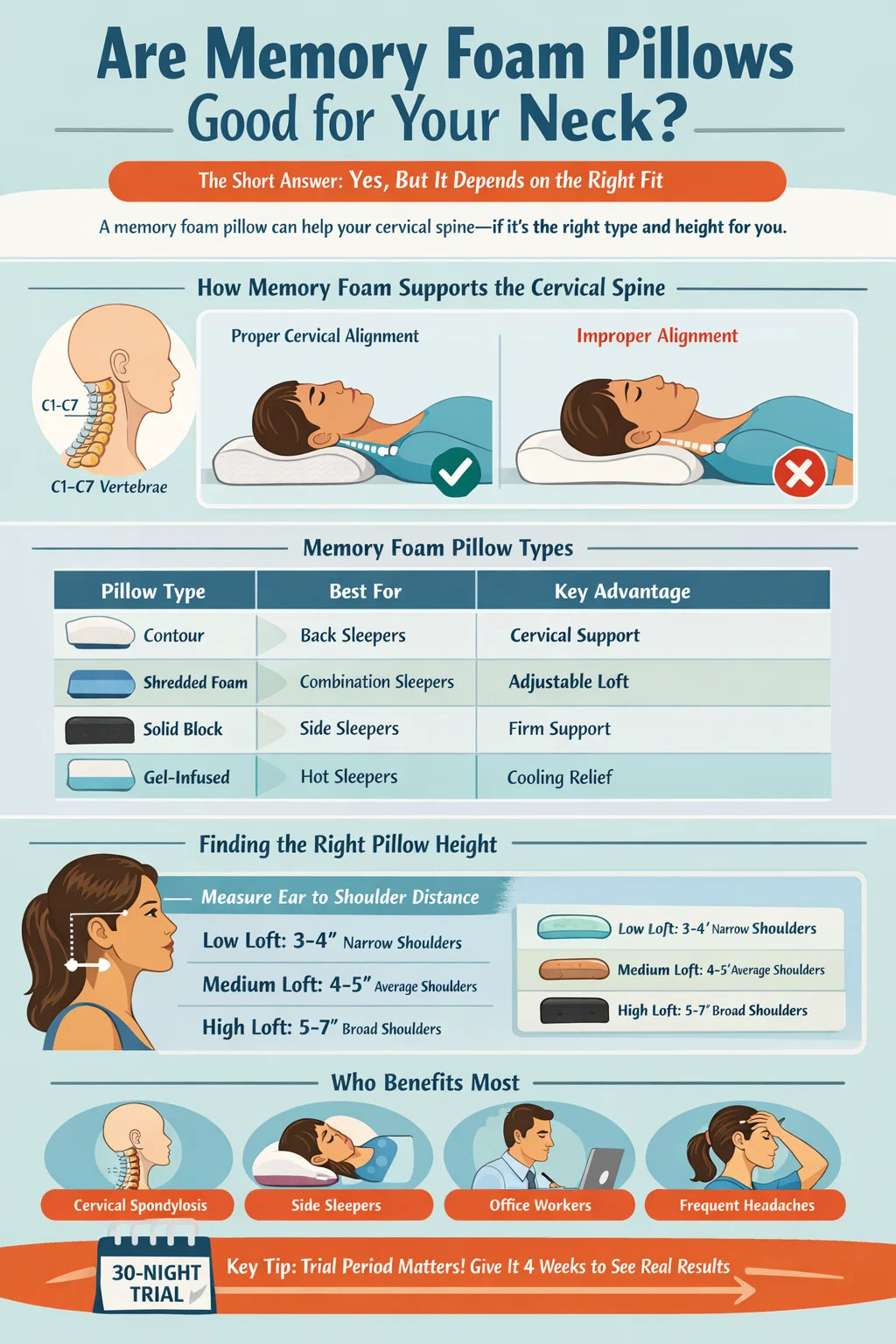
The Short Answer: Yes, But It Depends on the Right Fit
A memory foam pillow can be genuinely beneficial for the cervical spine — but only when it matches your sleeping position, body size, and specific neck condition. This is not a one-size-fits-all solution. The material itself is not magic; what makes memory foam work is its ability to conform to the natural curve of your neck and redistribute pressure away from sensitive vertebral joints. Studies have shown that improper pillow height is one of the leading causes of chronic neck pain, and memory foam's adaptive structure helps address this by eliminating the gaps between your neck and the sleeping surface that traditional pillows often leave.
According to a 2011 study published in the Journal of Pain Research, participants who switched to contour memory foam pillows reported a statistically significant reduction in neck pain and improved sleep quality compared to those using conventional pillows. However, the study also noted that individuals who selected the wrong loft height experienced no improvement or even worsening symptoms. So, the material matters — but so does the selection process.
How Memory Foam Actually Supports the Cervical Spine
To understand why memory foam pillows are frequently recommended for cervical health, it helps to understand what the cervical spine actually needs during sleep. The cervical spine — consisting of seven vertebrae (C1 through C7) — has a natural lordotic curve, meaning it curves slightly inward toward the front of the body. During sleep, this curve needs to be maintained, not flattened or exaggerated.
Traditional polyester or down pillows tend to compress unevenly under the weight of your head, often collapsing in the center and failing to support the neck arch. Memory foam, by contrast, is a viscoelastic material — it responds to both heat and pressure, softening where your head applies the most weight and firming up where support is needed. This creates a customized cradle effect that supports the cervical lordosis rather than fighting against it.
Pressure Relief at the Occipital Region
The occipital region — the base of the skull — tends to accumulate significant pressure during sleep, especially for back sleepers. Memory foam distributes this pressure across a wider surface area, reducing focal stress on the atlas (C1) and axis (C2) vertebrae. This pressure redistribution is why many people report waking up with less stiffness at the back of the head and upper neck after switching to a memory foam pillow.
Spine Alignment Throughout the Night
Unlike a feather pillow that shifts as you move, memory foam returns to its molded shape gradually. This means that even if you shift positions during the night, the pillow maintains a consistent support profile. Cervical alignment is not just important when you first lie down — it matters across all 6–8 hours of sleep. Memory foam's slow-recovery property (typically 3–5 seconds return time) helps maintain consistent contact between the pillow and your neck throughout sleep cycles.
Memory Foam Pillow Types and Which One Works Best for Neck Pain
Not all memory foam pillows are built the same. The market currently offers several distinct formats, each suited to different needs. Choosing the wrong type can be just as counterproductive as using a pillow that's the wrong height.
| Pillow Type | Best For | Key Advantage | Limitation |
|---|---|---|---|
| Contour / Ergonomic | Back sleepers | Pre-shaped cervical arch support | Not ideal for side sleepers |
| Shredded Memory Foam | Combination sleepers | Adjustable loft, breathable | Less consistent than solid foam |
| Solid Block | Side sleepers | Uniform support, no shifting | Can retain heat, less moldable |
| Gel-Infused Memory Foam | Hot sleepers with neck pain | Cooling properties + cervical support | Heavier, higher cost |
| Cervical Roll / Bolster | Those with diagnosed cervical issues | Targeted under-neck support | Needs to be used with flat pillow |
For most people dealing with general cervical discomfort, a contour memory foam pillow with dual-loft zones (one higher ridge, one lower ridge) offers the most versatile support. The higher side accommodates side sleeping, while the lower side works for back sleeping. This design directly mirrors the recommendations often given by physical therapists for cervicogenic headaches and upper trapezius tension.
The Right Pillow Height Matters More Than You Think
Pillow loft — the height of the pillow — is arguably the most critical factor for cervical spine health. Even the highest-quality memory foam pillow will cause neck problems if it's too tall or too flat for your body proportions. A pillow that's too high pushes the head forward, straining the posterior cervical muscles and compressing the facet joints. A pillow that's too low allows the head to drop, stretching the lateral neck muscles and destabilizing the atlanto-axial joint.
How to Determine the Right Loft for You
The ideal pillow height corresponds to the distance between your ear and the outer edge of your shoulder — your shoulder width. As a general guide:
- Narrow shoulders (under 16 inches) → Low loft: 3–4 inches
- Average shoulders (16–18 inches) → Medium loft: 4–5 inches
- Broad shoulders (over 18 inches) → High loft: 5–7 inches
For back sleepers, these measurements shift lower by about 1 inch since the shoulder is not a factor in lateral elevation. Memory foam pillows that come in adjustable or shredded formats allow you to add or remove fill to dial in the exact height, making them more forgiving for people who are uncertain of their ideal loft.
The Mirror Test
A practical method: lie on the pillow in your usual sleep position and have someone photograph your spine from behind or the side. Your cervical spine should form a straight horizontal line (side view for back sleepers, straight vertical line for side sleepers). If your head tilts up or down more than 5–10 degrees, the loft needs adjustment.
Who Benefits Most from a Memory Foam Pillow
Memory foam pillows are not universally superior for every person, but certain groups see the most consistent improvement from switching to them.
People with Cervical Spondylosis
Cervical spondylosis — degenerative disc disease affecting the neck — affects approximately 85% of people over age 60. The reduced disc height and increased bone spur activity in spondylosis makes the neck more sensitive to poor sleep positioning. Memory foam's ability to cradle without pushing back excessively makes it a commonly recommended option by orthopedic specialists for this condition. The reduced pressure on already-compressed discs can translate to measurably less morning stiffness.
Side Sleepers
Side sleeping is the most common position — studies suggest about 60–70% of people sleep predominantly on their sides. In this position, the pillow needs to bridge the gap between the mattress and the side of the head without either collapsing or elevating too sharply. Memory foam's density (typically between 3.0–5.0 lb/ft³ for quality pillows) provides the sustained resistance needed to keep the cervical spine neutral throughout the night without the need for constant readjustment.
Office Workers with Forward Head Posture
Forward head posture — where the head sits an inch or more in front of the ideal vertical alignment over the shoulders — adds roughly 10 pounds of effective load per inch of forward shift to the cervical spine. This posture, increasingly common among people who work at computers, causes chronic muscle fatigue and facet joint irritation. A correctly fitted memory foam pillow can provide passive cervical traction during sleep, gently encouraging the neck back into a neutral position over weeks of consistent use.
People with Frequent Tension Headaches
Many tension headaches originate from suboccipital muscle tightness — the small muscles at the base of the skull. Poor pillow support keeps these muscles contracted overnight, leading to headaches that are present upon waking. A memory foam pillow that supports the occipital region without pressing into it can significantly reduce the frequency of these morning headaches. Clinical experience from physiotherapy practices suggests a 30–50% reduction in headache frequency for patients who address their pillow situation alongside treatment.
Situations Where a Memory Foam Pillow May Not Be the Best Choice
There are scenarios where memory foam is either not the ideal solution or needs to be paired with other interventions.
- Stomach sleepers: Memory foam pillows, particularly contour styles, are poorly suited for prone sleeping. Stomach sleeping itself places the cervical spine in extreme rotation and extension, and even the best pillow cannot fully compensate. Stomach sleepers are generally advised to transition to side or back sleeping, regardless of pillow type.
- People with latex allergies: Some memory foam blends incorporate latex layers for resilience. Those with latex sensitivities should verify composition before purchasing.
- Heat-sensitive sleepers: Traditional memory foam is a closed-cell material that traps heat. If you already sleep hot, a standard memory foam pillow may worsen sleep quality through temperature discomfort. Gel-infused or open-cell memory foam variants address this, but they're typically more expensive.
- People with acute cervical injuries: An acute whiplash injury or post-surgical cervical condition requires specific medical guidance. In these cases, a physical therapist or orthopedic surgeon should advise on pillow type. A standard memory foam pillow, even a good one, is not a substitute for medically prescribed cervical positioning.
- Children under 12: The cervical spine in growing children has different curvature requirements, and adult memory foam pillows are not designed for pediatric proportions. Children typically require lower-loft, softer options.
What to Look for When Buying a Memory Foam Pillow for Cervical Support
The market is flooded with memory foam pillows making cervical health claims. Not all of them deliver. Here are the specific features that separate genuinely supportive memory foam pillows from those that merely use "cervical" as a marketing term.
Density
Foam density is measured in pounds per cubic foot (lb/ft³). For cervical support purposes, look for a density of 3.0–5.0 lb/ft³. Pillows below 3.0 lb/ft³ compress too easily and don't maintain support through the night. Above 5.0 lb/ft³ can feel uncomfortably hard and may actually impede circulation or cause pressure points.
ILD Rating (Indentation Load Deflection)
ILD measures how much force is needed to indent the foam by 25%. For pillows, an ILD of 10–14 is soft, 14–20 is medium, and above 20 is firm. A medium ILD around 14–18 works well for most cervical support applications. Pillows that don't disclose their ILD are often lower-quality products that can't guarantee consistent performance.
CertiPUR-US Certification
This certification ensures the foam is free from ozone-depleting substances, PBDEs, TDCPP, TCEP flame retardants, mercury, lead, and other heavy metals — all of which can off-gas from lower-quality foam products. Given that you'll be spending 6–8 hours per night with your face near this pillow, material safety matters.
Cover Breathability
Look for covers made from bamboo-derived rayon, Tencel, or cotton with a thread count of at least 200. These materials allow moisture wicking and airflow through the pillow surface, compensating for the heat retention of the foam itself. Avoid polyester covers, which trap both heat and moisture.
Trial Period and Return Policy
Memory foam pillows require a break-in period — typically 2–4 weeks — before your body adjusts to the new support profile. Reputable manufacturers offer at least a 30-night trial period. If a company doesn't offer this, that's a signal worth noting. Your neck needs time to adapt, and evaluating a new pillow after just a few nights will often give a misleading result.
How to Use a Memory Foam Pillow Correctly for Maximum Cervical Benefit
Even a good pillow produces poor results if used incorrectly. These are the most common usage errors that reduce cervical benefit.
- Don't double up pillows. Placing a second pillow on top of a memory foam pillow defeats its purpose. The custom contouring effect depends on the foam being the topmost contact surface. Adding another pillow forces an unnatural flexion of the neck.
- Position the pillow correctly for your sleep style. For contour pillows, the higher ridge goes under the neck for side sleeping and the lower ridge supports the neck for back sleeping. Many people unknowingly use contour pillows backwards.
- Allow it to expand fully before first use. Memory foam pillows compressed during shipping may need 24–48 hours to fully expand to their intended shape. Using the pillow before full expansion gives an inaccurate test of its actual support profile.
- Maintain shoulder position. For side sleepers, ensure your bottom shoulder is not tucked under your body, as this elevates the torso relative to the neck and changes the effective loft requirement. The shoulder should rest on the mattress in front of you, not underneath.
- Replace when necessary. Memory foam pillows have a typical lifespan of 2–3 years before they lose their resilience and support characteristics. A pillow that has passed this point often looks fine but no longer provides adequate cervical support. If you wake up with more stiffness than a year ago and haven't changed your sleep habits, the pillow may be the culprit.
Memory Foam vs. Other Pillow Materials for Cervical Health
It's worth putting memory foam in context against the other common pillow materials, particularly for those deciding whether to switch.
| Material | Cervical Support | Durability | Temperature | Adjustability |
|---|---|---|---|---|
| Memory Foam | Excellent | 2–3 years | Warm | Low–Medium |
| Latex | Very Good | 3–5 years | Neutral | Low |
| Down / Feather | Poor–Fair | 1–2 years | Warm | High |
| Polyester Fiberfill | Poor | 6–12 months | Variable | Medium |
| Buckwheat | Good | 3+ years | Cool | High |
| Water-Fill | Good–Very Good | 2–4 years | Cool | High |
Latex pillows are the closest competitor to memory foam for cervical support. They offer similar contouring without the heat retention, and they tend to last longer. The trade-off is higher cost and less availability. For people who run hot during sleep and still want strong cervical support, a natural latex pillow is often the better long-term investment. Memory foam, however, remains the more accessible and extensively researched option for most consumers.
Practical Signs That Your Current Pillow Is Hurting Your Cervical Spine
Many people don't realize their pillow is contributing to cervical problems because the connection isn't always obvious. These are the clearest indicators that your current pillow situation is negatively affecting your neck health:
- Neck stiffness or pain that is worst immediately upon waking and improves throughout the morning — this pattern strongly suggests a sleep positioning problem rather than a movement-related injury.
- Headaches that begin at the base of the skull and radiate toward the forehead (cervicogenic headaches) occurring 3 or more times per week.
- Tingling or numbness in the hands or fingers upon waking — this can indicate cervical nerve compression exacerbated by poor pillow support.
- Shoulder ache on one side upon waking, particularly if you consistently sleep on that side — insufficient pillow loft for your shoulder width causes persistent upper trapezius strain.
- Your pillow visibly flattens under the weight of your head, forming a noticeable indentation that doesn't recover — this means it's no longer providing functional support.
- You frequently wake up having switched to sleeping on your arm instead of the pillow — an unconscious adaptation your body makes when the pillow isn't providing adequate support.
If three or more of these apply to you, trialing a properly fitted memory foam pillow is a reasonable first step before pursuing medical evaluation, as pillow-related cervical issues are highly correctable without intervention when caught early.
Final Thoughts: Memory Foam Pillow as Part of a Cervical Health Strategy
A memory foam pillow is a legitimate and often meaningful tool for supporting cervical spine health during sleep — but it works best as part of a broader approach. Pairing a well-fitted memory foam pillow with consistent cervical strengthening exercises (particularly deep neck flexor work), attention to daytime posture, and a mattress with appropriate firmness for your body weight creates compounding benefits that a pillow alone cannot achieve.
The cervical spine is exposed to considerable load throughout the waking hours. Sleep is the body's primary recovery window — and the conditions under which that recovery occurs matter. Spending 7–8 hours each night with the neck in a poorly supported position can undo the benefits of even the most diligent daytime posture habits. Addressing the sleep environment is not a secondary concern; for many people dealing with chronic neck pain, it's actually the highest-leverage change they can make.
Choose a memory foam pillow appropriate for your sleep position and shoulder width, give it a genuine 4-week trial, and evaluate results honestly. For many people, this single change produces a measurable and lasting improvement in cervical health and overall sleep quality.